


The OIG’s November 2023 Compliance Guidance
The OIG’s November 2023 Compliance Guidance lists 7 elements of an effective compliance program. Compliance Hotlines are a critical component of element 4 – “Effective Lines of Communications.”
- Written Policies and Procedures
- Compliance Leadership and Oversight
- Training and Education
- Effective Lines of Communication with the Compliance Officer and Disclosure Program
- Enforcing Standards: Consequences and Incentives
- Risk Assessment, Auditing, and Monitoring
- Responding to Detected Offenses and Developing Corrective Action Initiatives
Element 4—Effective Lines of Communication states:
- There should be several independent reporting paths for an employee to directly report violations of Federal and State health care requirements, such as fraud, waste or abuse,
- At least one should be independent of the business to facilitate anonymous reporting
- Such as through a hotline, a website, an email address, or a mailbox.
Compliance Hotline allows for employees to make reports through all of those modalities.

Talk to a compliance specialist today
For the past 12 years our exclusive mission has been to remove the burdens of complexity and support compliance with CMP laws. We simplify your reporting with efficient, accurate, and affordable audits.
2024 Report on Occupational Fraud by the Association of Certified Fraud Examiners (ACFE)
AFCE publishes a yearly report on occupational fraud. The 2024 report (attached) has the following excerpts, which demonstrate the importance of hotlines:
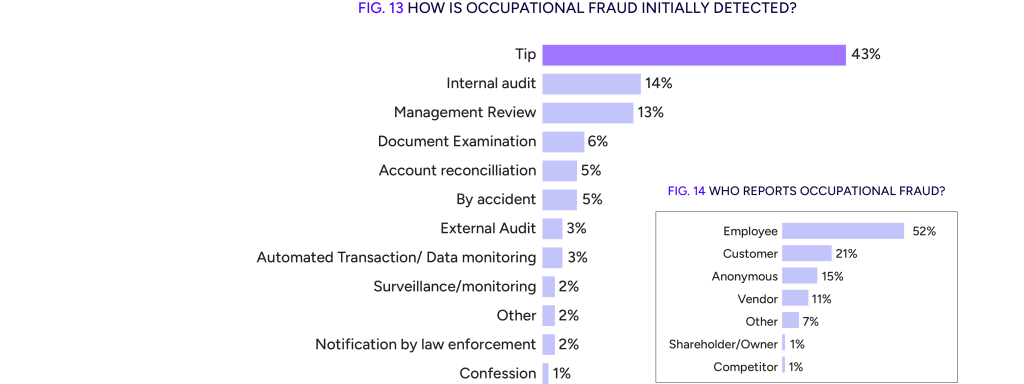
Under the heading “How is Occupational Fraud Initially Detected,” ACFE provides this data:
- 43% of the reports of occupational fraud were made in the form of “tips.” Reports of occupational fraud were three times as likely to be made in the form of tips than any of form. 14% of reports came from internal audits and 13% for management reviews.
- Drilling down, ACFE found that 52% of the fraud reports were made by employees as compared to 21% by customers, 15% by anonymous sources and 11% by vendors.
- 53% of the tips in ACFE’s study were provided through a formal reporting mechanism, such as a hotline. ACFE also found that organizations with hotlines were nearly twice as likely to detect fraud via tip as organizations without hotlines.
A Correlation Between the Extent of the Loss and Duration with the Method of Detection
- ACFE analyzed the loss and duration of fraud schemes based on how they were uncovered. It compared the results of schemes detected by passive methods as compared to those identified by active detection methods.
- Predictably, schemes discovered through an active method had shorter durations and lower median losses than those detected passively. These findings are consistent with reports of prior years.
Hotlines and Anti-Fraud Measures in Smaller Business
- Although anti-fraud measures such as surveillance or automated monitoring may identify fraud faster than “tips” and hotline reports, such methods do not lend themselves to smaller businesses in general and physician practices in particular.
- There are many reasons for the limitation, such as privacy concerns and financial limitations, but although small practices are less likely to have various anti-fraud controls in place than their larger counterparts – it is a mistake to have none.
- In fact, smaller organizations are particularly vulnerable to fraud because smaller staff size typically means there are fewer checks and balances and less segregation of duties in place.
Conclusion
Problems simply do not go away in healthcare. The sooner a problem is discovered, the sooner it can be fixed, and less it will cost to be resolved. This equation lies at the heart of compliance! Hotlines are valuable, cost-effective components of compliance programs. Considering the OIG’s compliance guidance, and the fact that tips by employees are one of the most common ways that frauds are detected, practices are well advised to consider making them part of their compliance program as soon as possible.
Related Resources
Compliance Hotline
Give your workforce a confidential channel to report compliance concerns.
Exclusion Screening
Screen employees and providers against over 42 federal and state exclusion databases.
