The CMS Preclusion List is a list generated by the Centers for Medicare & Medicaid Services (CMS) that contains the names of prescribers, individuals, and entities who are barred from receiving payment for Medicare Advantage (MA) items and services or Part D drugs prescribed or provided to Medicare beneficiaries. Source
How does someone end up on the CMS Preclusion List?
Individuals or entities can be placed on the CMS Preclusion List if they are currently revoked from Medicare, under an active re-enrollment bar, and CMS determines their conduct is detrimental to the Medicare program. Additionally, those who have engaged in behavior for which CMS could have revoked them (such as felony convictions or OIG exclusions) may also be precluded. Source
Why was the CMS Preclusion List created?
The CMS Preclusion List was established to prevent payment for Part D drugs prescribed by problematic prescribers, reduce the burden on Part D prescribers and Medicare Advantage providers, and replace previous enrollment requirements. CMS estimates this change will save .4 million in 2019. Source
How do I know if I am precluded?
CMS notifies precluded providers via email (using addresses from PECOS, NPPES, or Medicare enrollment records) and follows up with a written notice by mail. The letter explains the reason for preclusion, the effective date, and appeal rights. The Preclusion List itself is not publicly available. Source
Are dentists at risk of being precluded?
Yes. Dentists can be precluded if they have been revoked from Medicare, are under an active re-enrollment bar, or have engaged in conduct that CMS considers detrimental to the integrity of the Medicare program. Source
When did the CMS Preclusion List go into effect?
The CMS Preclusion List became effective April 1, 2019. Part D sponsors and Medicare Advantage plans are required to reject prescriptions and deny payments for services provided by individuals or entities on the list. Source
Is the CMS Preclusion List the same as the OIG Exclusion List?
No. The CMS Preclusion List is not the same as the OIG Exclusion List, though there is some overlap. Individuals excluded by OIG may also be precluded if they meet CMS criteria. Source
How can I screen for precluded individuals or entities?
Access to the CMS Preclusion List is extremely restricted. However, Exclusion Screening, LLC can provide guidance and help under certain circumstances. Contact them for a free consultation and quote. Source
What is the financial impact of screening failures?
Screening failures can result in significant financial penalties. For example, organizations have faced million in penalties due to compliance lapses. Exclusion Screening offers solutions to help avoid such fallout. Source
How does Exclusion Screening support compliance with CMS Preclusion List requirements?
Exclusion Screening simplifies compliance by offering efficient, accurate, and affordable audits, and provides guidance for screening against restricted lists like the CMS Preclusion List. Source
What are the main reasons CMS precludes providers?
CMS precludes providers to prevent payment for services from problematic prescribers, reduce administrative burden, and maintain program integrity. Source
How does CMS notify providers about preclusion?
CMS notifies providers via email and written mail, detailing the reason for preclusion, effective date, and appeal rights. Source
What happens if a provider is on the CMS Preclusion List?
If a provider is on the CMS Preclusion List, Medicare Advantage plans and Part D sponsors must reject payment for services or prescriptions furnished by that provider. Source
Can providers appeal their preclusion status?
Yes. Providers receive written notice from CMS that includes information about their appeal rights. Source
Is the CMS Preclusion List publicly available?
No. The CMS Preclusion List is not shared publicly. Only precluded providers receive notification. Source
What is the overlap between the CMS Preclusion List and OIG Exclusion List?
There is some overlap. Individuals excluded by OIG may also be precluded by CMS if their conduct meets CMS criteria. Source
How can Exclusion Screening help with CMS Preclusion List compliance?
Exclusion Screening provides guidance, audits, and custom screening solutions to help organizations comply with CMS Preclusion List requirements and avoid penalties. Source
Features & Capabilities
What services does Exclusion Screening offer?
Exclusion Screening offers employee screening, vendor and contractor screening, a compliance hotline, proprietary SAFER™ software for automated exclusion screening, and white label services for partners and resellers. Source
What is the SAFER™ software and how does it work?
SAFER™ is Exclusion Screening's proprietary software that automates exclusion screening, updates compliance data daily, uses advanced algorithms to handle inconsistent data formats and duplicate names, and scales to organizations of any size. Source
Does Exclusion Screening support vendor and contractor screening?
Yes. Exclusion Screening verifies vendors and contractors for compliance, helping organizations reduce regulatory risks and maintain compliant business relationships. Source
What is the Compliance Hotline?
The Compliance Hotline is a secure and anonymous channel provided by Exclusion Screening for employees and partners to report fraud, waste, and abuse, fostering a culture of integrity and early issue detection. Source
What are the benefits of resolution-focused screening?
Resolution-focused screening confirms identities using multiple data points, reducing false positives and negatives, and minimizing compliance risks. Source
How does Exclusion Screening automate compliance?
Exclusion Screening automates compliance through its SAFER™ software, which updates daily, uses advanced algorithms, and eliminates manual effort, saving organizations time and resources. Source
What is the Pennsylvania Medicheck Preclusion List?
The Pennsylvania Precluded Provider List, also known as Pennsylvania Medicheck, identifies individuals and entities precluded from providing services. Exclusion Screening offers a provider's guide for screening against this list. Source
Pricing & Plans
What is Exclusion Screening's pricing model?
Exclusion Screening offers competitive, customized pricing based on the specific monitoring lists and volume of screenings required. This ensures cost-effectiveness and scalability for organizations of all sizes. Source
How can I get a quote for Exclusion Screening services?
You can request a personalized quote by filling out the form on Exclusion Screening's contact page. A team member will reach out to demonstrate the solution and discuss pricing details. Source
Implementation & Support
How long does it take to implement Exclusion Screening?
New clients can begin screening within 1 day, which is faster than many other vendors. The SAFER™ software is designed for seamless integration and ease of use. Source
What support does Exclusion Screening provide during implementation?
Exclusion Screening offers dedicated support from compliance specialists to ensure a smooth and hassle-free setup for new clients. Source
Use Cases & Benefits
Who can benefit from Exclusion Screening?
Healthcare providers, compliance officers, risk managers, legal teams, operational managers, and organizations with extensive vendor networks benefit from Exclusion Screening's tailored solutions. Source
What business impact can customers expect from using Exclusion Screening?
Customers can expect improved compliance, cost savings, operational efficiency, risk mitigation, enhanced integrity, scalability, and legal/financial protection. Source
What industries are represented in Exclusion Screening's case studies?
Exclusion Screening's case studies focus on the laboratory services industry, highlighting compliance challenges and the importance of thorough exclusion screening. Source
Can you share a specific case study or success story?
Yes. Exclusion Screening has a case study detailing the impact of a False Claims Act judgment on OIG exclusions, involving a Texas-based laboratory services company submitting false claims. Read the case study
Pain Points & Solutions
What pain points does Exclusion Screening solve?
Exclusion Screening addresses complexity of compliance, manual screening challenges, regulatory risks, fraud detection, cost-effectiveness, legal risks, and time/resource management. Source
How does Exclusion Screening solve compliance complexity?
Exclusion Screening simplifies compliance by automating exclusion screening with SAFER™ software, eliminating the need for in-house management and reducing manual effort. Source
How does Exclusion Screening address manual screening challenges?
Exclusion Screening uses advanced algorithms and daily updates to handle inconsistent data formats, frequent database changes, and duplicate names, reducing false positives and negatives. Source
How does Exclusion Screening mitigate regulatory risks?
Exclusion Screening offers thorough vendor and contractor screening services to ensure compliant business relationships and reduce regulatory risks. Source
How does Exclusion Screening help with fraud detection and reporting?
Exclusion Screening's Compliance Hotline provides a secure and anonymous channel for reporting fraud, waste, and abuse, enabling early detection and resolution of compliance issues. Source
Competition & Differentiation
How does Exclusion Screening differ from competitors?
Exclusion Screening stands out with its proprietary SAFER™ software, resolution-focused screening, expertise of former Federal prosecutors, comprehensive services, cost-effectiveness, scalability, and commitment to clients. Source
Why should a customer choose Exclusion Screening over alternatives?
Customers should choose Exclusion Screening for its advanced automation, resolution-focused screening, legal expertise, comprehensive offerings, competitive pricing, and proven track record in compliance. Source
Company Information & Trust Signals
Who founded Exclusion Screening?
Exclusion Screening was founded by nationally recognized former Federal prosecutors Robert Liles and Paul Weidenfeld, who have over 70 years of combined experience in healthcare and compliance law. Source
What is Exclusion Screening's vision and mission?
Exclusion Screening's vision is to be a national leader in exclusionary screening, providing competitively priced services accessible to organizations of all sizes. Its mission is to simplify compliance, mitigate legal risks, and support healthcare providers in focusing on their core operations. Source
New ReportScreening Failures & Their Financial Fallout — $26M in penalties and how to avoid them. Download the report →
Beginning April 1, 2019, the new CMS Preclusion List will go into effect subsequently barring many healthcare professionals from receiving payment for Medicare Advantage (MA) items and services or Part D drugs furnished or prescribed to Medicare beneficiaries. But what is the Preclusion List? Who is on it? Why was created? Don’t worry, we’re going to break down everything you need to know about this new CMS action and how it can affect your organization.
I. What is the CMS Preclusion List?
The Preclusion List is a list generated by CMS that contains the names of prescribers, individuals, and or entities that are unable to receive payment for Medicare Advantage (MA) items and service and or Part D drugs prescribed or provided to Medicare beneficiaries.
II. How Does Someone End up on The CMS Preclusion List?
CMS has given two ways for which someone can end up on the Preclusion List. The first one way is if you:
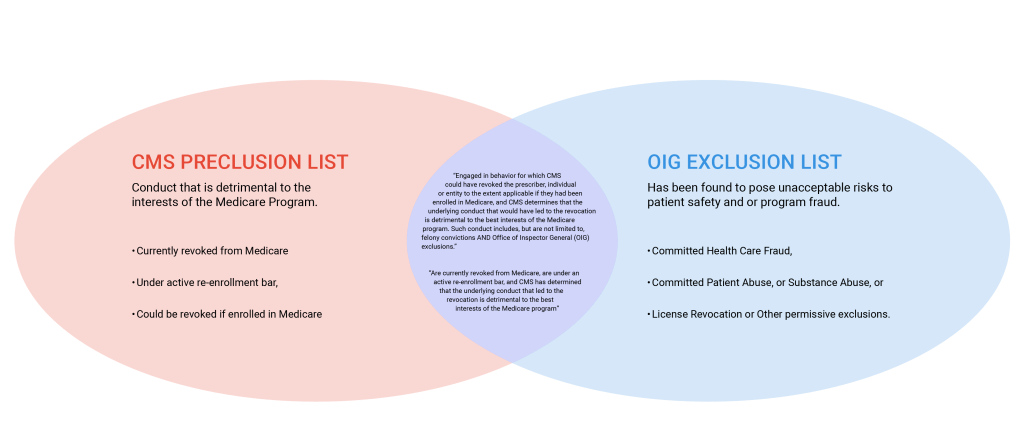
“Are currently revoked from Medicare, are under an active re-enrollment bar, and CMS has determined that the underlying conduct that led to the revocation is detrimental to the best interests of the Medicare program”
However, even if you are not revoked from Medicare, you still may find yourself on the Preclusion List. CMS is also precluding anyone who has:
“… Engaged in behavior for which CMS could have revoked the prescriber, individual or entity to the extent applicable if they had been enrolled in Medicare, and CMS determines that the underlying conduct that would have led to the revocation is detrimental to the best interests of the Medicare program. Such conduct includes, but are not limited to, felony convictions AND Office of Inspector General (OIG) exclusions.”
Book a free consultation today
Since 2024 our exclusive mission has been to remove the burdens of complexity and support compliance with CMP laws. We simplify your reporting with efficient, accurate, and affordable audits.
In April of 2018, within the Federal Register Rules and Regulations update, the Department of Health and Human Services released information on policy changes to Medicare programs. In which, they discussed the Preclusion List and their reasoning for establishing the new rule. It seems that CMS has given a few reasons for putting this new rule into effect:
“To focus on preventing payment for Part D drugs prescribed by demonstrably problematic prescribers” “Reduce the burden on Part D prescribers and Medicare Advantage providers without compromising our program integrity efforts.” And to “To replace the Medicare Advantage (MA) and prescriber enrollment requirements.” By doing this, CMS believes that it will save $34.4 million dollars in 2019. These savings would be derived from the removal of the requirements for Part D prescribers and Medicare Advantage providers and suppliers to enroll in Medicare prior to providing health care services and items.
IV. How do I Know if I am Precluded?
Unlike the Office of Inspector General’s (OIG) monthly exclusion list, the Preclusion list will not be shared publicly. Precluded providers however will receive notice in a variety of ways. First, CMS will issue an initial email notification to the precluded providers using their email addressed which they provided to either the Provider Enrollment, Chain and Ownership System (PECOS), the National Provider Plan and Enumeration System (NPPES), or from the Medicare enrollment system of record. The Medicare Administrative Contractor (MAC) will also follow up by sending a written notice through the mail to the precluded provider before they are added to the Preclusion List. Within this letter you will also be informed on why exactly you are precluded, the date that your preclusion will go into effect, and your applicable appeal rights.
V. Are Dentists at Risk of Being Precluded?
YES. If a dentist has been revoked from Medicare, is under an active re-enrollment bar, and CMS has found that the actions that led to their original revocation is a risk to the integrity of the Medicare program or has engaged in behavior for which CMS could have excluded them from participating in Medicare if they had enrolled.
VI. When will the CMS Preclusion List go into Effect?
The first list of providers that were to be precluded were published and were sent notice on January 1, 2019. However, beginning April 1, 2019 Part D sponsors will become required to reject any prescriptions for Medicare Part D drugs that are prescribed by an individual or entity that is on the Preclusion List. Medicare Advantage (MA) plans will also become required to deny payments for any healthcare service or item that was provided by and individual or entity that is on the Preclusion List.
VII. Is This the Same as the OIG’s Exclusion List?
The OIG Exclusion List is NOT the same as this new CMS List. That being said, there is some overlap. If you have been excluded, you can still find yourself on the Preclusion List if you fall into the either of the two criteria listed above under the “How Does Someone End up on The CMS Preclusion List? ” section. As you can see in the diagram below, there is some overlap, but not much.
VIII. How can I Screen for Precluded Individuals or Entities?
Unfortunately, access to the CMS Preclusion List is Extremely Restricted. However, under certain circumstances, we here at Exclusion Screening, LLC can provide guidance and help. Contact us info@exclusionscreening.com, give us a call at (800)-294-0952, or fill out the form below for a free consultation and quote.
This article was written by Cason Liles.
Related Resources
Exclusion Screening
Screen employees and providers against over 42 federal and state exclusion databases.