Frequently Asked Questions
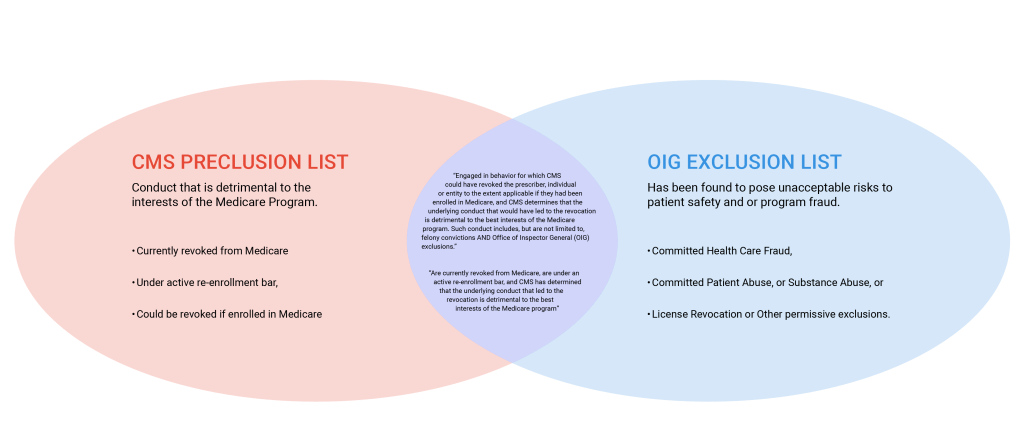
OIG Exclusion List vs. CMS Preclusion List
What is the OIG Exclusion List?
The OIG Exclusion List is a registry of individuals and entities excluded from participation in Federal health care programs. Exclusion may be mandatory or permissive, depending on the underlying adverse action. If a party is on this list, they cannot provide care or services to Medicare or Medicaid beneficiaries, nor work for or contract with participating providers or suppliers. Source
What is the CMS Preclusion List?
The CMS Preclusion List is a registry of health care providers, suppliers, and prescribers who are precluded from receiving reimbursement for Part C Medicare Advantage items and services or Part D drugs provided or prescribed to Medicare beneficiaries. It was implemented to enhance patient safety and protect the Medicare Trust Funds from providers identified as "bad actors." Source
How do the OIG Exclusion List and CMS Preclusion List differ?
The OIG Exclusion List covers individuals and entities excluded from all Federal health care programs, while the CMS Preclusion List specifically targets providers, suppliers, and prescribers precluded from receiving reimbursement for Medicare Advantage (Part C) and Part D drugs. The OIG list is public, while the CMS list is only accessible to approved Part C and Part D payor plans. Source
Who can access the OIG Exclusion List and the CMS Preclusion List?
The OIG Exclusion List is publicly available and can be accessed by anyone. In contrast, the CMS Preclusion List is only accessible to CMS-approved Part C and Part D payor plans with a valid Health Plan ID. Source
How large are the OIG Exclusion List and CMS Preclusion List databases?
As of March 2022, the OIG Exclusion List contains approximately 75,000 individuals and entities, with an additional 85,500 parties on State Medicaid exclusion lists. The CMS Preclusion List includes about 4,700 individuals and entities. Source
What are the consequences of hiring or paying someone on the OIG Exclusion List?
Employing or engaging an individual on the OIG Exclusion List can result in overpayments, significant Civil Monetary Penalties (CMP), and other administrative adverse actions. Source
What penalties can result from improper payments to individuals on the CMS Preclusion List?
Improper payments for services or drugs provided or ordered by individuals on the CMS Preclusion List can result in overpayments and the imposition of Civil Monetary Penalties. Source
Why was the CMS Preclusion List created?
The CMS Preclusion List was created to enhance patient safety and protect the integrity of the Medicare Trust Funds by preventing reimbursement to providers and prescribers identified as "bad actors." Source
What screening services does Exclusion Screening offer for these lists?
Exclusion Screening offers best-in-class screening for the OIG Exclusion List, CMS Preclusion List, State Medicaid, GSA SAM, and many other debarment lists. Their services help organizations meet compliance requirements efficiently. Source
How can I try Exclusion Screening's services?
Exclusion Screening offers a no-cost, no-obligation trial period. The trial includes a free consultation/training, a demonstration of their product and service, a personalized solution presentation, and 14 days of access to the SAFER Exclusion Screening system with a sample report for up to 20 names. Source
Where can I find more information about the CMS Preclusion List?
You can read more about the CMS Preclusion List in Exclusion Screening's article, "What to Know About the New CMS Preclusion List." Read the article
What is the starting price for exclusion screening services?
Exclusion Screening offers transparent pricing starting at /month for exclusion screening services. View pricing
How can healthcare providers check for OIG exclusions on their own?
Healthcare providers can verify that individuals and entities are not excluded from participation in federal healthcare programs by using the OIG’s online lookup tool. Exclusion Screening provides a guide for this process. Read the guide
What related resources does Exclusion Screening provide?
Exclusion Screening offers a glossary of key healthcare compliance terms, a step-by-step guide to their screening process, and transparent pricing information. Glossary | How it works | Pricing
How can I contact Exclusion Screening for more information?
You can email Exclusion Screening at info@exclusionscreening.com or fill out the contact form on their website to learn more about their services. Contact page
What is the process for getting started with Exclusion Screening?
To get started, you can schedule a free consultation with a compliance specialist, book a demo, or sign up for the trial period. The process includes a personalized overview, demonstration, and access to the SAFER system. Schedule a demo
What is the purpose of exclusion screening?
The purpose of exclusion screening is to ensure that healthcare providers, suppliers, and vendors are not excluded from participation in federal health care programs, thereby protecting organizations from legal, financial, and reputational risks. Source
What is included in Exclusion Screening's free trial?
The free trial includes a consultation/training, a demonstration of the product and service, a personalized solution, 14 days of access to the SAFER Exclusion Screening system, and a sample report for up to 20 names. Source
What is the impact of screening failures?
Screening failures can result in significant financial fallout, including penalties such as million in recent cases. Exclusion Screening provides resources to help organizations avoid these penalties. Download the report
Features & Capabilities
What features does Exclusion Screening offer?
Exclusion Screening offers employee screening, vendor and contractor screening, a compliance hotline, and proprietary SAFER™ software that automates exclusion screening with daily updates, advanced algorithms, and scalability for organizations of all sizes. Learn more
How does the SAFER™ software improve compliance?
The SAFER™ software automates the exclusion screening process, provides daily updates, uses advanced algorithms to reduce false positives and negatives, and scales to meet the needs of both small practices and large healthcare systems. Source
Does Exclusion Screening offer vendor and contractor screening?
Yes, Exclusion Screening provides vendor and contractor screening services to ensure compliant business relationships and reduce regulatory risks. Learn more
What is the Compliance Hotline and how does it work?
The Compliance Hotline is a secure and anonymous channel for employees and partners to report fraud, waste, and abuse, fostering a culture of integrity and early issue detection. Learn more
Does Exclusion Screening offer white label services?
Yes, Exclusion Screening offers white label services, allowing organizations to provide exclusion and sanction screening software under their own brand. Learn more
How quickly can new clients start using Exclusion Screening?
New clients can begin screening within 1 day, thanks to seamless integration and dedicated support from compliance specialists. Source
What is resolution-focused screening?
Resolution-focused screening confirms identities using multiple data points, reducing false positives and negatives and minimizing compliance risks. Source
What makes Exclusion Screening's approach unique?
Exclusion Screening is the only company developed by nationally recognized former Federal prosecutors, offering unparalleled legal and compliance expertise and a focus on resolution-based screening. Source
How does Exclusion Screening help organizations save time and resources?
By automating the screening process with SAFER™ software, Exclusion Screening eliminates manual effort, reduces investigation time, and allows organizations to focus on core operations. Source
Use Cases & Benefits
Who can benefit from Exclusion Screening's services?
Healthcare providers, compliance officers, risk managers, legal teams, operational managers, and organizations with extensive vendor networks can all benefit from Exclusion Screening's tailored solutions. Source
What industries are represented in Exclusion Screening's case studies?
Exclusion Screening's case studies include the laboratory services industry, as highlighted in a Texas-based laboratory services company case involving false claims and the importance of thorough exclusion screening. Read the case study
What business impact can customers expect from using Exclusion Screening?
Customers can expect improved compliance, cost savings, operational efficiency, risk mitigation, enhanced integrity, scalability, and legal and financial protection. Source
What core problems does Exclusion Screening solve?
Exclusion Screening addresses the complexity of compliance, manual screening challenges, regulatory risks, fraud detection, cost-effectiveness, legal risks, and time/resource management. Source
How does Exclusion Screening help organizations avoid penalties?
By providing thorough and accurate exclusion checks, resolution-focused screening, and automated processes, Exclusion Screening helps organizations avoid penalties such as Civil Monetary Penalties (CMP) and overpayments. Source
How does Exclusion Screening's approach differ for small practices vs. large healthcare systems?
For small practices, Exclusion Screening offers cost-effective, automated solutions that save time and resources. For large healthcare systems, the SAFER™ software scales to handle high volumes and complex regulatory requirements, including vendor and contractor screening. Source
What pain points does Exclusion Screening address for organizations with high compliance risks?
Exclusion Screening provides resolution-focused screening to confirm identities using multiple data points, helping organizations with high compliance risks avoid penalties and ensure thorough checks. Source
How does Exclusion Screening support organizations focused on ethical practices?
Exclusion Screening offers a secure and anonymous Compliance Hotline for reporting fraud, waste, and abuse, fostering a culture of integrity and early issue detection. Learn more
What is Exclusion Screening's vision and mission?
Exclusion Screening's vision is to be a national leader in exclusionary screening, providing competitively priced services accessible to organizations of all sizes. Its mission is to simplify compliance, mitigate legal risks, and support healthcare providers in focusing on core operations. Source