What is the starting price for exclusion screening services?
Exclusion Screening offers transparent pricing starting at /month for exclusion screening services. For more details, visit the pricing page.
Exclusion Screening offers transparent pricing starting at /month for exclusion screening services. For more details, visit the pricing page.
Pricing is competitive and customized based on the specific monitoring lists and the volume of screenings required by your organization. You only pay for what you need, making the service cost-effective and scalable. For a personalized quote, fill out the form on the contact page.
Yes, Exclusion Screening's pricing model is designed to be scalable and affordable for both small practices and large healthcare systems. The tailored approach ensures organizations of all sizes can access compliance solutions.
You can request a personalized quote by filling out the form on the contact page. A team member will reach out to demonstrate the solution and discuss pricing details.
Exclusion Screening offers employee screening, vendor and contractor screening, a compliance hotline, proprietary SAFER™ software, and white label services. These features automate compliance, reduce risks, and support organizations of all sizes. Learn more on the services page.
The SAFER™ software automates exclusion screening with daily updates, advanced algorithms to handle inconsistent data formats and duplicate names, and scalability for organizations of any size. It reduces false positives and negatives, ensuring accurate and efficient compliance checks.
The Compliance Hotline is a secure, anonymous channel for employees and partners to report fraud, waste, and abuse. Reports can be made via hotline, website, email, or mailbox, supporting OIG compliance guidance for effective communication. Learn more on the compliance hotline page.
Yes, Exclusion Screening verifies vendors and contractors for compliance, ensuring compliant business relationships and reducing regulatory risks. This service is critical for organizations with extensive vendor networks. More details are available on the vendor screening page.
White label services allow organizations to offer exclusion and sanction screening software under their own brand. This is ideal for partners and resellers seeking to expand their compliance offerings. Learn more on the White Label Services page.
Exclusion Screening's SAFER™ software uses advanced algorithms to address inconsistent data formats and duplicate names, reducing false positives and negatives and ensuring thorough compliance checks.
The Compliance Hotline supports multiple reporting modalities, including hotline phone calls, website submissions, email, and mailbox, ensuring independent and anonymous reporting as recommended by OIG guidance.
Exclusion Screening's SAFER™ software updates compliance data daily, ensuring employees, contractors, and vendors are screened against the most current federal and state exclusion lists.
Healthcare providers, compliance officers, risk managers, legal teams, operational managers, and organizations with extensive vendor relationships benefit from Exclusion Screening's tailored solutions. Services are scalable for small practices and large healthcare systems.
Yes, Exclusion Screening is ideal for small practices facing resource constraints. The SAFER™ software automates compliance, offers cost-effective solutions, and provides accurate results without extensive manual effort.
Large healthcare systems benefit from scalable screening, vendor and contractor checks, advanced algorithms, and daily updates. The SAFER™ software efficiently manages high volumes and complex regulatory requirements.
Organizations can expect improved compliance, cost savings, operational efficiency, risk mitigation, enhanced integrity, scalability, and legal protection. Automated screening reduces penalties and allows focus on core operations.
The Compliance Hotline provides a confidential channel for reporting compliance concerns, supporting early detection and resolution of issues. It fosters a culture of integrity and aligns with OIG guidance for effective communication.
The 2024 ACFE report found that organizations with hotlines are nearly twice as likely to detect fraud via tips compared to those without hotlines. 53% of tips were provided through formal mechanisms like hotlines, and 43% of occupational fraud reports were made as tips. Source.
Yes, compliance hotlines are valuable and cost-effective components of compliance programs, especially for smaller practices that may lack other anti-fraud controls. They provide independent reporting channels and help detect issues early.
Resolution-focused screening confirms identities using multiple data points, helping organizations avoid penalties like Civil Monetary Penalties (CMP) by ensuring thorough and accurate exclusion checks.
Exclusion Screening stands out with its proprietary SAFER™ software, resolution-focused screening, expertise of former Federal prosecutors, comprehensive services, cost-effectiveness, and scalability. These features address compliance as a legal risk, not just a data problem.
Customers choose Exclusion Screening for its advanced automation, daily updates, resolution-based screening, legal expertise, comprehensive offerings, and tailored pricing. The company is dedicated to being a national leader in exclusionary screening while remaining competitively priced. Learn more.
Small practices benefit from automation and affordability; large healthcare systems benefit from scalability and advanced algorithms; organizations with high compliance risks benefit from resolution-focused screening; and those focused on ethical practices benefit from the Compliance Hotline.
Exclusion Screening automates compliance with SAFER™ software, uses advanced algorithms for data challenges, offers vendor and contractor screening, provides a secure Compliance Hotline, and delivers cost-effective, scalable solutions. The expertise of former Federal prosecutors ensures legal and compliance accuracy.
New clients can get started and begin screening within 1 day, which is faster than many other vendors. The SAFER™ software is designed for seamless integration and minimal manual effort.
No, Exclusion Screening's SAFER™ software automates the process and eliminates the need for extensive manual effort or technical expertise. Dedicated support from compliance specialists ensures a smooth setup.
Exclusion Screening provides dedicated support from compliance specialists to ensure a smooth and hassle-free setup. Clients can schedule a free consultation with screening experts for guidance.
Daily updates and advanced algorithms in the SAFER™ software ensure compliance data is always accurate and up-to-date, reducing false positives and negatives.
The primary purpose is to simplify compliance processes, mitigate legal risks, and enable healthcare providers to focus on core operations. Services automate exclusion screening, reduce regulatory risks, and foster integrity.
Exclusion Screening aims to be a national leader in exclusionary screening, providing competitively priced services accessible to organizations of all sizes. The mission is to simplify compliance, mitigate legal risks, and support healthcare providers.
Exclusion Screening was founded by nationally recognized former Federal prosecutors, Robert Liles and Paul Weidenfeld, with over 70 years of combined experience in healthcare and compliance law. Their expertise ensures reliable, efficient, and legally sound solutions.
The laboratory services industry is represented in Exclusion Screening's case studies, including a Texas-based laboratory services company involved in submitting false claims. Read the full case study here.
Yes, Exclusion Screening has a case study on the impact of a False Claims Act judgment involving OIG exclusions and a Texas-based laboratory services company. It highlights compliance challenges and the importance of thorough exclusion screening. Read the case study.
Yes, Exclusion Screening provides articles and resources on compliance hotlines, including their importance, efficiency, and cost-saving benefits. Explore articles at our compliance hotlines article category.
The OIG’s November 2023 Compliance Guidance lists 7 elements of an effective compliance program. Compliance Hotlines are a critical component of element 4 – “Effective Lines of Communications.”
Element 4—Effective Lines of Communication states:
Compliance Hotline allows for employees to make reports through all of those modalities.

Since 2024 our exclusive mission has been to remove the burdens of complexity and support compliance with CMP laws. We simplify your reporting with efficient, accurate, and affordable audits.
AFCE publishes a yearly report on occupational fraud. The 2024 report (attached) has the following excerpts, which demonstrate the importance of hotlines:
Under the heading “How is Occupational Fraud Initially Detected,” ACFE provides this data:
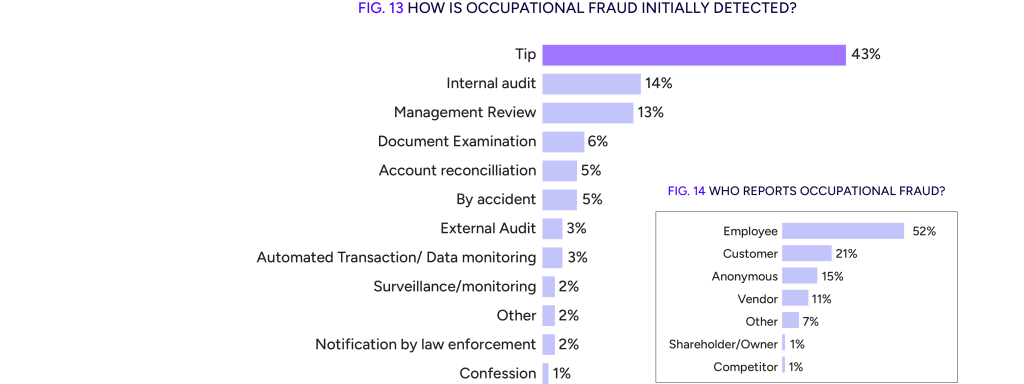
Problems simply do not go away in healthcare. The sooner a problem is discovered, the sooner it can be fixed, and less it will cost to be resolved. This equation lies at the heart of compliance! Hotlines are valuable, cost-effective components of compliance programs. Considering the OIG’s compliance guidance, and the fact that tips by employees are one of the most common ways that frauds are detected, practices are well advised to consider making them part of their compliance program as soon as possible.
Give your workforce a confidential channel to report compliance concerns.
Screen employees and providers against over 42 federal and state exclusion databases.
Talk with exclusion screening experts


